Car insurance
Car Insurance Rates Are Falling. So Why Isn't Yours?
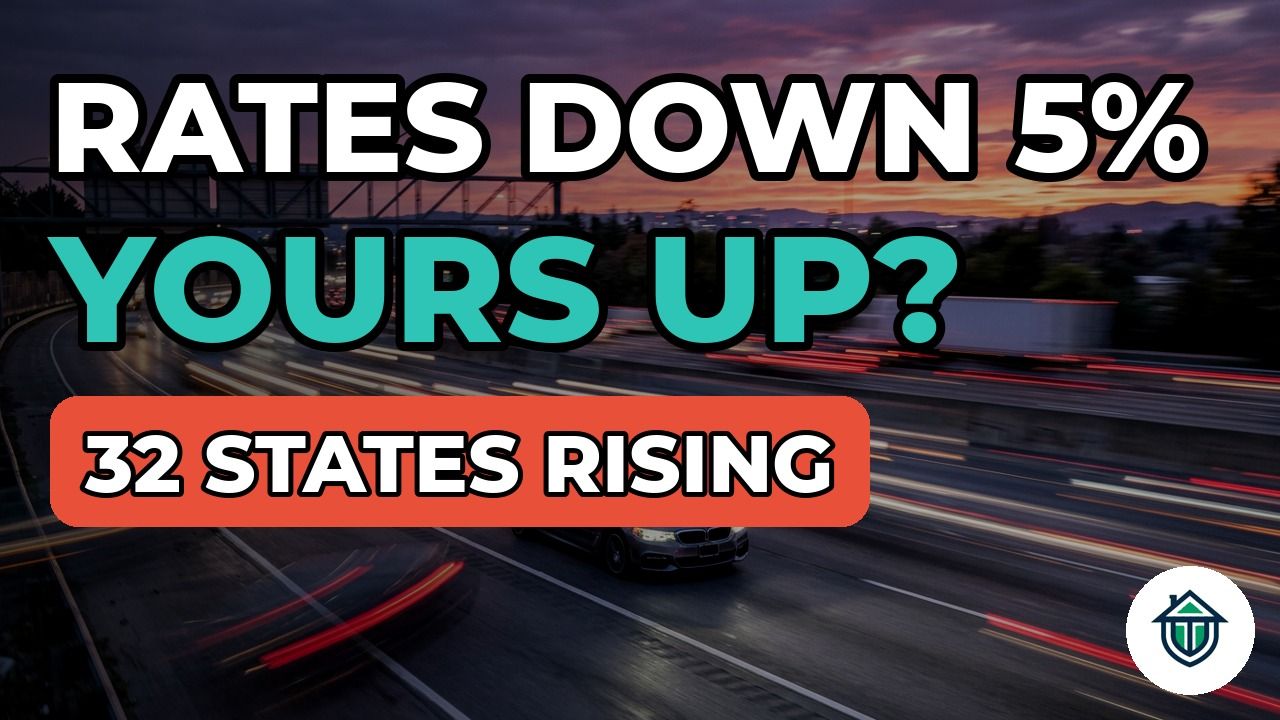
Car insurance just got cheaper. Officially. The government's price index for auto insurance is down 5 percent from a year ago. So why did your renewal notice go up?
Because two very different numbers are hiding behind the headlines. Here is how to untangle them, who is actually getting rate cuts, and the renewal math that shows how to claim your share.
Are car insurance prices really falling?
By one important measure, yes. The Bureau of Labor Statistics reported that its motor vehicle insurance index fell 5.0 percent in the 12 months through September 2026.
Context matters, though. By The Auto Wire's calculation from the published data, the same index jumped 16.3 percent from September 2023 to September 2024, then rose another 3.1 percent the following year. It peaked in February 2026 and, in unadjusted terms, has fallen every month since. Even after that slide, it is still about 14 percent above September 2023. Prices are coming down from a mountain, not returning to normal.
Why so many drivers feel nothing
The index tracks the price of a fixed policy over time. What you actually pay depends on your state, your insurer, your car and your life.
Insurify, which analyzes hundreds of millions of quotes, put the national average for full coverage at $2,237 a year at mid-2026, up 1 percent since the end of 2025, and projects 32 states will end the year with higher average rates. The split is dramatic. Insurify projects Connecticut drivers will finish 2026 paying about 14.7 percent more, Kentucky about 8.3 percent and West Virginia about 7.9 percent more, and Nevada about 5.7 percent more. New Mexico is projected down about 8.2 percent, and Washington, D.C., New Jersey and New York down roughly 4 to 5 percent.
Real payment data tells the same story. The Bank of America Institute, reported by Insurance Business, tracked what its customers paid insurers for auto, home and renters policies: in the year through August, the median payment rose just 1 percent, compared with about 6 percent the year before and roughly 12 percent the year before that. Gen Z households still saw increases close to 6 percent. Geography matters even more than age: median payments fell about 8 percent in Orlando, Tampa and Jacksonville and about 7 percent in Miami, while Los Angeles and San Diego posted increases of around 5 to 6 percent.
Why the index fell at all
The losses that drove the spike have been fading. According to Department of Transportation data cited by the Bank of America Institute, crashes per million miles jumped in 2021 and then mostly declined through 2024. Federal safety officials estimated traffic deaths fell 8.2 percent in the first half of 2025, and vehicle replacement costs, a big driver of claim size, peaked in 2022 and have eased since.
Repair bills have not cooperated, though. The BLS index for vehicle maintenance and repair rose 5.8 percent over the past year, so claims are not getting cheap.
Who is getting the cuts?
Rate changes are filed insurer by insurer, state by state. LexisNexis found that in early 2026, 35 percent of auto rate revisions were decreases, 39 percent were increases and 26 percent held flat.
Real examples from regulators this month: Connecticut's Insurance Department highlighted filings with decreases, including about 8.4 percent on average for two State Farm companies, about 14 percent for Farmers Casualty, and about 6 percent for a Liberty Mutual company covering roughly 11,500 policyholders. In Florida, regulators approved USAA auto rate decreases averaging 7 percent across more than 498,000 policies.
The renewal math
Rate cuts usually show up at renewal, and only if your insurer filed one in your state. Take an illustrative driver, Maya, who pays $2,237 a year for full coverage, exactly the national average, with her renewal five weeks away:
- If her insurer passes along a cut the size of the national index (5 percent): she pays about $2,125, saving $112.
- If her insurer files a cut like State Farm's in Connecticut (8.4 percent): she pays about $2,049, saving $188.
- If she lives somewhere trending like Connecticut overall (up 14.7 percent) and never shops: she pays about $2,566, or $329 more.
Now compare all of that with the shopping gap. Insurify says drivers with similar backgrounds can see full-coverage quotes ranging from about $100 to $200 a month, a spread of up to $1,200 a year for essentially the same driver. The biggest lever is not the market trend. It is whether you compare.
Discounts stack on top. Insurify notes that bundling auto with a home or renters policy can bring discounts of up to 25 percent. On Maya's premium, that could be up to about $559.
What you can do
- Mark your renewal date and start comparing three to four weeks before it.
- Ask your insurer directly: did you file a rate change in my state, and does it apply to me?
- Get at least three quotes with identical limits and deductibles, so you compare like with like.
- Ask about bundling, paid-in-full, autopay and low-mileage discounts.
- Do not slash your liability coverage to save a few dollars. It protects your savings if you cause a serious crash.
- If a charge or cancellation looks wrong, contact your state insurance department. Connecticut's department, for example, publicly encourages drivers to ask questions about their premiums.
Car insurance is getting cheaper on average, but the cut is not automatic. The drivers who benefit most are the ones who check. Your renewal is your moment.
Watch the video
Sources
- Bureau of Labor Statistics, Consumer Price Index, September 2026 (released October 14, 2026): bls.gov
- The Auto Wire, "Gas Up 34%, Insurance Down 5%," October 19, 2026: theautowire.com
- Insurify, 2026 Mid-Year Auto Insurance Report, August 11, 2026: insurify.com
- Bank of America Institute data and LexisNexis rate-filing data, via Insurance Business, October 16, 2026: insurancebusinessmag.com
- Connecticut Insurance Department, October 16, 2026: portal.ct.gov
- Florida Office of Insurance Regulation, USAA 7 percent auto rate decrease, October 26, 2026: floir.gov